The project began in mid-September with the basics: laying out the geometry for motors, pulleys, belts, and gears while staying within frame perimeter constraints. Early work focused on plate layouts and making sure there was enough space to mount hardware without interfering with the belt runs.
By late September, we finished the hood plate and met my first real challenge: problems with gear meshing. This would become an ongoing theme. In early October, after some research on Citrus Circuits’ shooter design, we had made the ambitious move to try and copy their gear by hand. This. did not go well. We learned quickly that precision gear geometry is not something you “eyeball.”
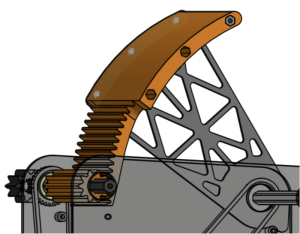
October brought a major breakthrough in using GearLabs and a Kraken gear profile to make a reliable mesh. The lesson was reinforced in all caps: DO NOT EYE BALL OR HAND MAKE GEARS. Once appropriate gear geometry was in place, we could proceed to complete the 3D printed part studio and further refine the geometry.
By mid October, talking to mentors and running calculations through ReCalc showed us that we had drastically underestimated RPM requirements for the shooter design. In other words, it was time for a change—big changes. We revised the 3D printed hood to decrease the minimum angle from 42° to 38°, a subtle change that allowed more reasonable RPM requirements.
We dropped the previous multi-wheel design in favor of a simpler solid hood. This drastically reduced complexity and created a more build-friendly mechanism. The next week, we implemented a physical hard-stop for the hood and completed a design review resulting in several major improvements.
By mid-November, CAD saw its biggest jump in quality. We optimized motor positions—lowering them to improve packaging—and fixed every item from the design review. One important note to my future self: dimension features to each other, not to unrelated sketches, unless you enjoy watching your entire CAD model turn red. Our CAD lead also showed us some pretty neat CAD tools like a sheet metal model, which was used to make the funnel. He also gave us ideas on changing the mounting method to improve the stability of the shooter.
Serious assembly started in late November. It was a tough few days riddled by interferences because the washers were not on the CAD. A reminder from one of our new mentors Sam stuck: “Don’t let perfect be the enemy of good enough.” It is a reminder to stick to a design to perfect it, and not jump to a new design every other week like this team has done in the past.
Assembly continued into December. A missing spacer forced us to take apart and reassemble the shooter, which took close to two hours. Good lesson to learn regarding future mechanical builds: use exploded views and if exploded views are not enough, provide written assembly instructions. We finally completed the shooter assembly.
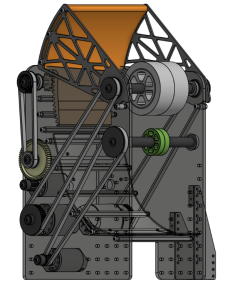
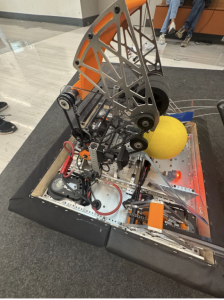
In retrospect, this shooter project was much more than a design exercise. It became a crash course in mechanical robustness, CAD best practices, iteration mindset, and team communication. Key takeaways for whoever is building a hooded shooter in the future:
- Run interference detection early. It saves time and the assembly team’s sanity
- Never model gears by hand. Use GEAR LABS and profiles of other gears
- Dimension to other things in the sketch, parametric design. Bad constraints cause catastrophic CAD failures.
- Do the math first with recalc, don’t just copy another team’s rations
- Perfect is not the goal; functional is.
- Exploded views save time by preventing assembly failure.
If you are interested in taking a closer look at our Infinite Recharge Shooter, we are planning to publish our CAD ahead of the Rebuilt Kick-off.