

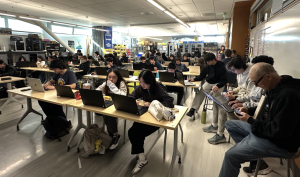
On kickoff day, our team immediately dissected every aspect of the new 2026 FRC game, “Rebuilt.” We constantly reviewed the field layout and put ourselves in the minds of the game designers to reverse-engineer strategy. Our team reviewed the manual for hours, and we broke out into groups to discuss our thoughts on certain rules.
Coordinating as a team again, we compiled our thoughts about the manual and then quizzed ourselves to truly master the game. With the game’s dimensions, regulations, and facets in mind, we started to strategize using previous lessons from our mentors’ presentations. We organized our functional requirements into four categories: shall have, expected, could have, and shan’t have. Once we finalized our robot’s functional requirements and expectations, we tackled our strategy for the game. This consisted of numerous pitches from our breakout group expressing what they thought was the best strategy for this game. We discussed whether we should utilize the trench by making our robot short, the possibility of stealing the fuel from the opponents, the benefits and downsides to using the human player, and how high we would want to climb the ladder.
Once we started our prototyping days, it was clear what we would want to see on a robot. We took notice of past FRC games that involved many spherical game pieces, such as the 2017 Steamworks game. Team 125, the “Nutrons,” utilized a spinning indexer in the center of their hopper to quickly sweep the floor of the hopper and funnel the balls straight up to their shooter. Then came our alpha bot, named Waffle House after the square-shaped waffle holes around its exterior. You can see it in all its waffly glory here: Waffle House’s drivetrain is powered by SDS MK5n modules, our best one yet. While some of us are working on the drivetrain, many other subsystems are working on prototyping. We have a group of students for each prototype we deemed important, and we are operating at full speed. For example, the turret prototype is almost finished, with a spinning shooter and even some storage. We aim to make it able to shoot on the move (SOTM) as well. The hardware subteam is also working really hard on the competition drivetrain, moving on to wiring all the core components. You can check it out here. The team’s goal is to have it completed by Work Day 12, 1/25/26.
One of our greatest assets this year is the field. Almost immediately after the game was released, our mentors worked tirelessly to remake the main components of the game, including the hub, the climb, the trench and bump, and the corral. Not just mentors, but some students also helped make the field, meaning that we now have life-sized objects to compare our ideas and prototypes too. Once we had the wood models in place, we got the real counterparts of them down, like a net, proper bumps, etc. You can track our build season progress at our website’s photo album.