
About James Smith

This author has not yet filled in any details.
So far James Smith has created 1 blog entries.

By , , , , ,  and |2026-09-20T14:09:04-07:00February 10th, 2026|

Prototyping Climb Decision: Telescoping arm - After weight and packaging considerations by the team at large, we made a DVC decision to redistribute the workforce of the windmill climb to the telescoping climb. The windmill design added extra structure and instability, which increased weight and made integration more difficult. The telescoping climb offered a more compact and straightforward solution that fit better with the rest of the robot. Refocusing the workforce allowed the team to improve reliability and spend more time testing and refining the final climb system.   Intake & Store: This week, we have been finalizing the wire management of the intake motor, as well as the mounting for the back wall of the hopper. We decided to use 3M Dual Lock to attach the back wall to the side walls, so it’s easier to access the battery and service other mechanisms above the drivetrain. We also decided to bend the back wall around our climb rather than go around it to make it easier to attach and detach. Spindexer: The CAD and design of the dye rotor were adjusted throughout the week. We were able to make a lot of progress CAD-wise, and we began manufacturing the hex shaft and [...]
By |2024-12-09T19:19:53-08:00November 13th, 2024|

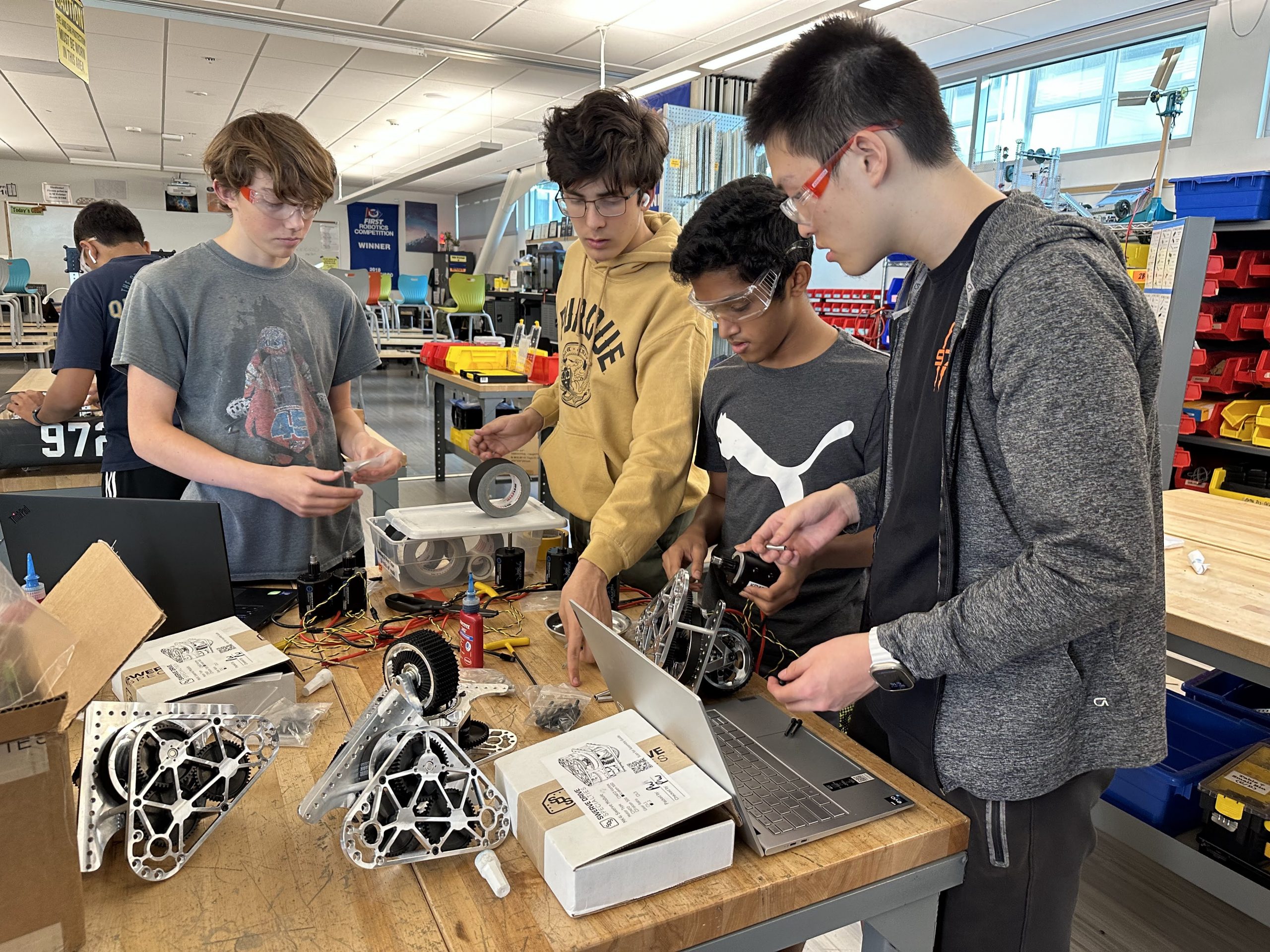
One of our off-season advanced projects is creating a cascade elevator. We previously made a continuous elevator for the 2023 Charged Up season, and we hope to expand our knowledge on creating robust elevators for the future. An elevator has been an important system used to achieve game tasks by many top teams in the past. An elevator is often used to manipulate game pieces to a raised position or to climb during the end game. Having an elevator allows for more scoring opportunities to gain an advantage during competition. Compared to a continuous elevator, a cascade elevator is faster due to the simultaneous movement of stages and has a consistent carriage motion, while being simpler to rig.  Going into the project, we set a goal to create an angle-adjustable 2-stage cascade elevator that can extend 4 feet in ~1 second and be able to lift the robot 2 feet off the ground. To learn about creating an elevator for the build season, we aimed to make the elevator fully functional on one of our swerve drivetrains to understand the process from start to finish. Due to our goal of creating an adjustable elevator, used a 7/8in diameter dead-axle tube mounted on an adjustable plate on the swerve drive base. The angle can then be fine-tuned with the carbon fiber [...]

Go to Top